


Are You Managing Burnout Symptoms While the Real Problem Goes Untreated?
As seen in Brainz, published on May 15, 2026
I had a client arrive at Africa Wellness not long ago. She had not slept properly in years, and I mean years. She had seen psychiatrists. She had tried antidepressants. She had taken the breaks her family kept suggesting. She had done the therapy. Nothing held. Within a few weeks of integrated treatment at Africa Wellness, she was sleeping every night. Properly. She told me she had never felt happier. She said we saved her life.
What changed was not her effort. Her effort had always been there. What changed was that we finally addressed the actual problem, not just the symptoms sitting on top of it.
The part nobody tells high performers about burnout
Most executives who come to us have been managing their burnout for years. Managing it well by most external measures. They are still in the meetings. Still closing the deals. Still performing. But underneath all of that, something has quietly shifted.
The decisions that used to feel fast now feel heavy. The mornings require something external to begin them. The sleep that used to come naturally stopped coming at all. No amount of rest, mindset work, or lifestyle adjustment has moved the needle the way they expected it to.
There is a reason for that. Executive burnout at this level is not a mindset problem. It is a biological one. Years of sustained, high-stakes pressure cause measurable physical changes inside the brain. The region responsible for decision-making, emotional regulation, and the ability to switch off actually shrinks under chronic stress. This shows up on a brain scan. It is not a metaphor.
Why the therapy did not stick
Here is something I see over and over again. Someone arrives having already done the work. Therapy. Coaching. A stint at another facility. They will tell me they understood everything. They agreed with the insights. But nothing changed.
Think of the brain like a garden. When someone has been under extreme pressure for long enough, the soil hardens. You can plant the best seeds in the world, better coping strategies, new perspectives, and healthier patterns, and nothing takes root. Not because the seeds are wrong. Because the soil has become concrete.
What we need to do first, before any therapy can land, is till the soil. Make the brain receptive again. That is exactly what Transcranial Magnetic Stimulation does.
What TMS is and what it is not
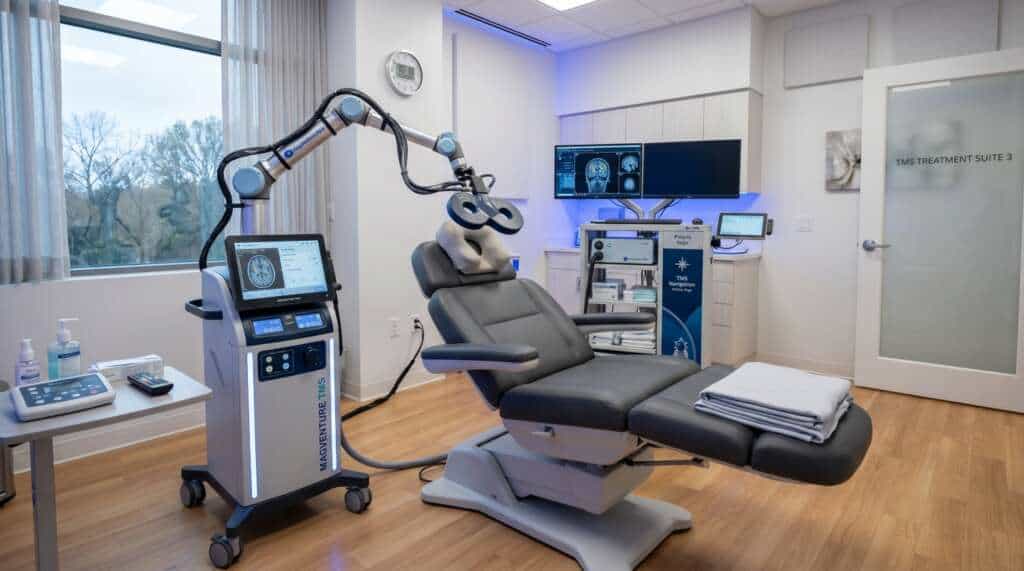
TMS uses targeted magnetic pulses to stimulate the specific regions of the brain that chronic stress has left underactive. The person sits fully awake in a comfortable chair. A coil is placed gently against the scalp. The pulses activate neurons that have essentially gone quiet under years of pressure. No anaesthesia. No medication. No recovery period. Clients drive themselves to the session and go back to their day.
I always need to address the comparison that comes up, because the confusion stops people before they start. TMS is not ECT. ECT involves a general anaesthetic and a controlled seizure. TMS involves neither. No sedation. No memory loss. No seizure. Just precise, targeted stimulation that tells the brain it is time to come back online.
When this is repeated across multiple sessions, the brain rewires itself. New neural connections form. The regions that burnout suppressed start functioning again. The clinical term is neuroplasticity. The brain changes its own structure.
What I have seen it do
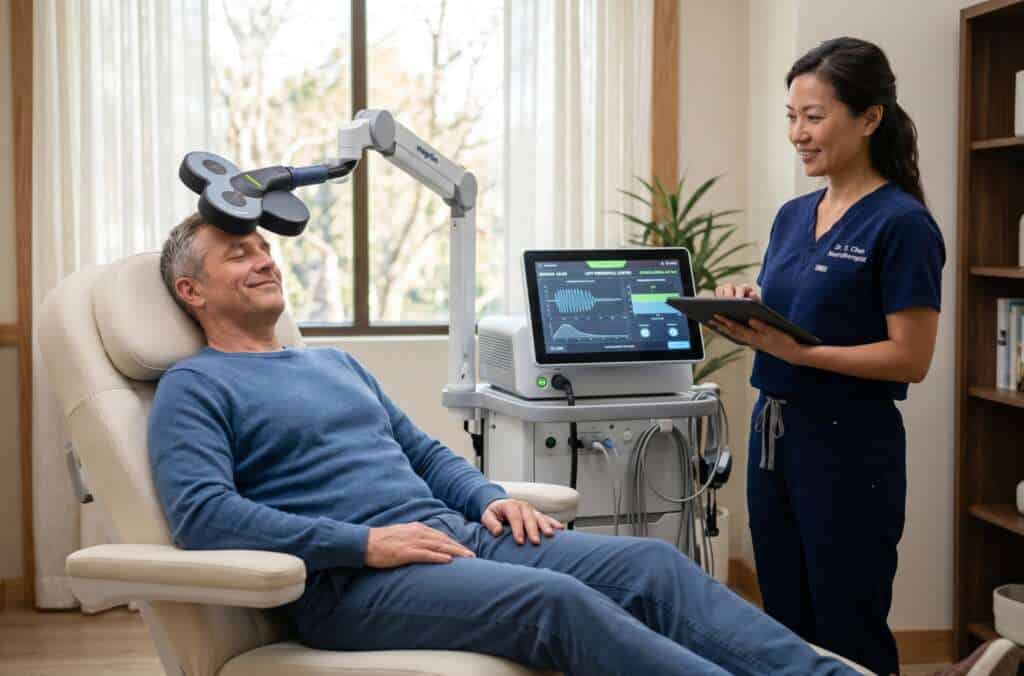
The pattern I see at Africa Wellness when TMS is integrated with therapy and our full clinical program is consistent. The fog lifts. The mornings become manageable. The decisions feel faster. The emotional steadiness that used to be automatic starts to return.
Critically, the therapy starts to work. Research shows that TMS combined with structured psychotherapy yields remission rates of 56 to 66 percent, compared to 30 to 40 percent with therapy alone. Once the brain is in a state of neuroplasticity, the insights have somewhere to land. The seeds finally find soft soil.
The executives who complete treatment at Africa Wellness do not describe becoming different people. They describe returning to who they already were. Before the pressure changed their chemistry, before the pattern became something they could not step out of on their own.
Why South Africa and why this matters





A full TMS course in the United Kingdom costs approximately 12,000 pounds. At Africa Wellness in South Africa, the same clinical quality of treatment is integrated into a comprehensive residency program at a fraction of that cost. South Africa is not a developing market for this treatment. The clinical infrastructure here is world-class, backed by serious research and serious facilities.
We work with one client at a time. Every assessment is comprehensive before any treatment begins, covering biomarker bloodwork, brain mapping, and a full psychiatric evaluation. The program that follows is built around what we actually find, not a standard template applied to everyone.
If you are an executive who has tried everything and found that nothing has held, it may not be the effort that was missing. It may be that the root cause has never been addressed. That is exactly where we begin.
